
Why Do Some Women Get PMDD and Others Don't? What Science Is Learning About the Genetics Behind It
🎧 Prefer to listen? This topic is covered in Episode 9 of the Sirona Health Podcast: Why Do Some Women Get PMDD and Others Don't? The Genetics Behind It
If you've ever felt like a completely different person in the week before your period — flooded with anxiety, rage, or despair that vanishes almost overnight once your period starts — you may have premenstrual dysphoric disorder, or PMDD. And if you've ever been told (by a doctor, a friend, or your own inner voice) that you should just be able to handle your hormones better, you'll be glad to hear that science increasingly disagrees.
For years, doctors assumed PMDD must be caused by some kind of hormone imbalance — too much of one hormone, too little of another. But when researchers actually measured hormone levels in women with PMDD, they found something surprising: they're completely normal. A woman with severe PMDD and a woman with no premenstrual symptoms at all can have identical levels of oestrogen and progesterone in their blood.
So if it's not the hormones themselves, what is it? A growing body of research suggests the answer lies not in how much hormone a woman is exposed to, but in how her cells and brain respond to that hormone — and that this difference in response may be written into her genes. Three recent studies help explain what that might actually look like, at a level most of us never get to see: inside individual cells and inside the brain in real time.
First, a clever experiment: taking hormones out of the equation
Before getting into the findings, it helps to understand how researchers even tested this. You can't easily tell, in a woman going through a normal monthly cycle, whether her symptoms are caused by her hormone levels or by something else changing at the same time. So scientists at the National Institutes of Health did something clever: they used a medication that temporarily shuts down the ovaries completely, putting hormone levels near zero. Then, in a carefully controlled way, they added back oestrogen and progesterone separately, without either the women or the researchers knowing which hormone was being given at any point.
This meant they could ask a very precise question: if you give the exact same dose of the exact same hormone to a woman with PMDD and a woman without it, does anything happen differently in her body or brain?
Time and again, the answer was: nothing different happened in women without PMDD. But in women with PMDD, something did.
Finding 1: A gene "dimmer switch" behaves differently in PMDD
The most direct genetic evidence comes from a 2017 study led by Dubey and colleagues. The researchers took blood cells from women who'd been through the hormone experiment above — some with confirmed PMDD, some without — and grew them in the lab. This let them look directly at which genes were switched on or off, something that's obviously much harder to do with living brain tissue.
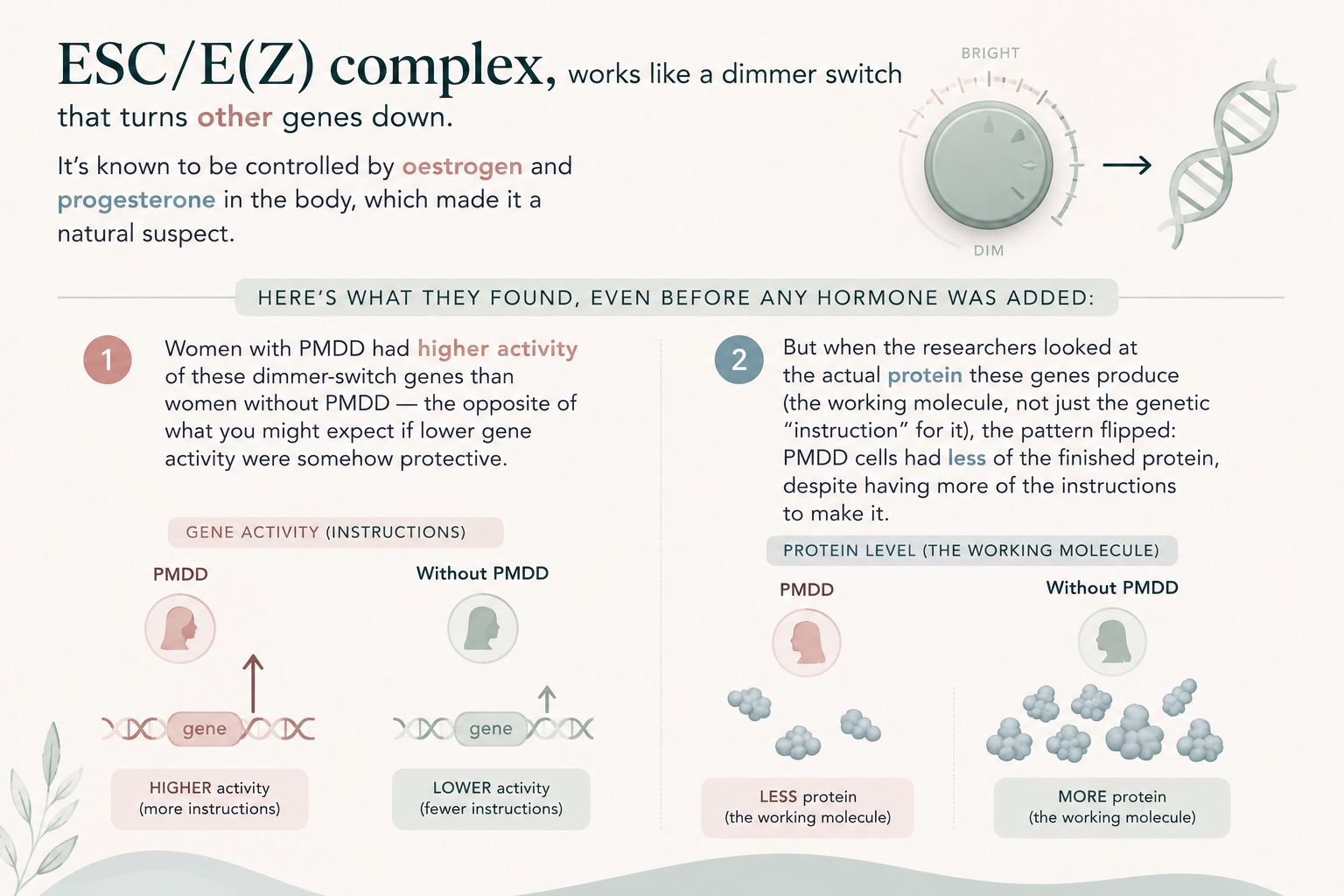
Think of your genes as a giant control panel, and certain proteins as the hands that turn specific dials up or down. One group of genes the researchers focused on, called the ESC/E(Z) complex, works like a dimmer switch that turns other genes down. It's known to be controlled by oestrogen and progesterone in the body, which made it a natural suspect.
Here's what they found, even before any hormone was added:
Women with PMDD had higher activity of these dimmer-switch genes than women without PMDD — the opposite of what you might expect if lower gene activity were somehow protective.
But when the researchers looked at the actual protein these genes produce (the working molecule, not just the genetic "instruction" for it), the pattern flipped: PMDD cells had less of the finished protein, despite having more of the instructions to make it.
That mismatch — more instructions, less finished product — is a strong clue that something is going wrong in the translation step, somewhere between "gene switched on" and "protein actually made and working." It's exactly the kind of subtle glitch that wouldn't show up on a hormone blood test, but might explain why the same hormone level produces a completely different experience in different women.
And when the researchers actually exposed these cells to oestrogen or progesterone in a dish, the two groups reacted differently. Progesterone switched three of these genes further up — but only in cells from women without PMDD. In PMDD cells, nothing happened. Oestrogen, meanwhile, switched one particular gene down — but only in PMDD cells. Same hormone, same dose, genuinely different genetic response depending on who the cells came from.
Finding 2: The same signature shows up in a mood-related part of the brain
A finding in a lab dish is interesting on its own, but it becomes much more convincing when it connects to something happening in a living brain. That's what a 2021 study by Wei and colleagues set out to test, using brain scans during that same careful hormone experiment.
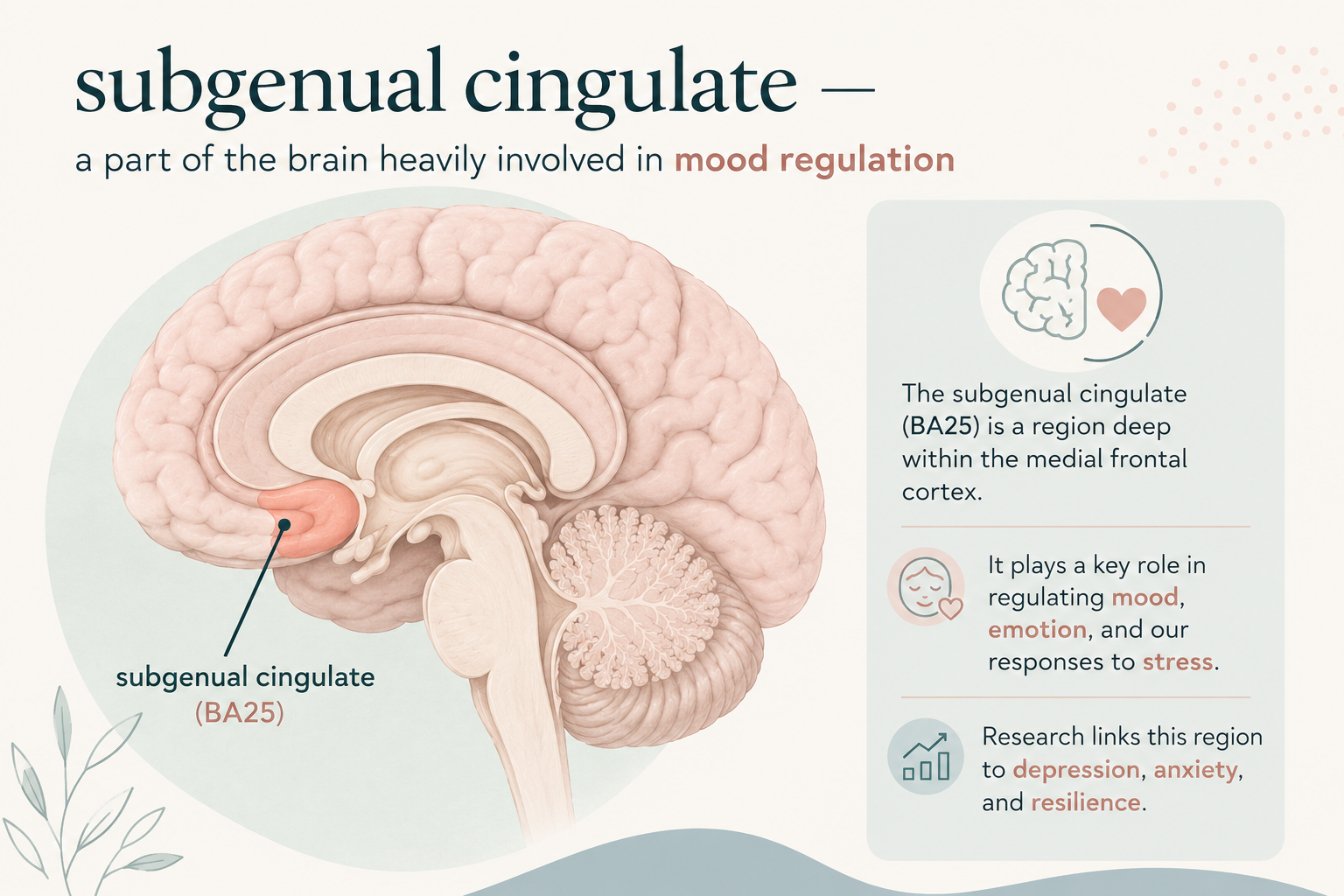
The researchers measured blood flow in the brains of 63 women — 43 without PMDD, 20 with it — while their hormones were suppressed, and then again during oestrogen and progesterone add-back. They were especially interested in one small but important region called the subgenual cingulate — a part of the brain heavily involved in mood regulation, and one that doctors already target with brain stimulation therapy in severe, treatment-resistant depression.
In women without PMDD, blood flow to this region stayed steady no matter which hormone they were given. In women with PMDD, blood flow to this same region dropped noticeably during both oestrogen and progesterone add-back — precisely the times when their PMDD symptoms tend to come roaring back.
Even more interesting: in a smaller group of women who'd taken part in both this brain-scan study and the gene-activity study above, the size of that brain blood-flow change tracked closely with each woman's individual gene "dimmer switch" pattern — but again, only in the women with PMDD. It's a small, early finding that needs to be confirmed in larger groups, but it's a real bridge between something measurable in a blood sample and something measurable in a functioning brain.
Finding 3: This fits a bigger picture of how genetics shapes mood differently in women
Zooming out, a broader 2021 review by Sikes-Keilp and Rubinow pulls together decades of research on why depression and mood disorders affect women and men so differently — and some of what they found is directly relevant here.
A few of the most striking points:
PMDD-type symptoms really do run in families. Twin studies suggest that around 56% of the risk for premenstrual syndrome (the broader category that includes PMDD) is genetic — a similar level of heritability to depression itself.
Male and female brains use largely different genes to "do" depression. When researchers compared gene activity in the brains of men and women with major depression, only about 5–10% of the affected genes overlapped between the sexes — and even the genes that did overlap were often switched in opposite directions. Two specific genes seemed to act as master hubs: one connected to depression in women, another connected to depression in men, and when scientists tested this directly in mice, changing the "female" gene caused depression-like behaviour only in female mice, and changing the "male" gene only affected male mice.
A specific hormone byproduct may explain postpartum depression. When progesterone breaks down in the body, one of the substances it produces, called allopregnanolone, calms the brain through the same system targeted by anti-anxiety medications. A sudden drop in this substance after childbirth is thought to contribute to postpartum depression in vulnerable women — and this discovery was significant enough that a version of allopregnanolone is now an approved treatment for postpartum depression.
Epigenetics — how genes get switched on and off — may be the missing link. This idea fits neatly with the "dimmer switch" findings above. Because these switches can flip back and forth (unlike a permanent genetic mutation), they offer a plausible explanation for why PMDD symptoms come and go in a monthly rhythm rather than staying constant — which is exactly what we see clinically.
Finding 4: PMDD and postnatal depression may share some of the same genetic roots
Since this article was first written, a large new genetic study has added another important piece to the puzzle.
Researchers combined health-record data from more than 900,000 Swedish women with large genetic studies of premenstrual disorders and postpartum depression. They found substantial genetic overlap between the two conditions. In the genetic analysis, the correlation between their inherited susceptibility was around 0.66 — suggesting that many of the genetic factors that make someone vulnerable to premenstrual mood symptoms may also make them vulnerable to depression following childbirth.
This doesn't mean that PMDD and postnatal depression are the same condition, or that every woman with one will develop the other. Postnatal depression has many different causes. But it supports an increasingly important idea: some women may inherit a particular vulnerability to the dramatic changes in reproductive hormones that occur at different stages of life.
The researchers also identified two new areas of the genome associated with both conditions. One involves a gene called KCTD16, which helps regulate GABA signalling — one of the brain's main inhibitory or "calming" systems. Intriguingly, another part of the GABA system is already central to our understanding of how the progesterone metabolite allopregnanolone affects mood.
So rather than discovering a single "PMDD gene", research is beginning to reveal something much more interesting: a complex network of genetic differences that may influence how the brain responds when reproductive hormones change. PMDD may be one expression of that vulnerability; for some women, postnatal depression may be another.
What this all adds up to
None of these three studies has found "the PMDD gene" — mood disorders are rarely that simple. But together, they sketch a coherent and genuinely reassuring story:
PMDD and related reproductive mood disorders have a real, measurable genetic component — not just a psychological or "willpower" one.
At the level of individual cells, genes that control the body's response to hormones behave differently in women with PMDD, both at rest and when directly exposed to oestrogen or progesterone.
That same genetic pattern lines up with how a key mood-related part of the brain responds to those same hormones.
This sits inside a much larger picture in which women's and men's brains handle mood-related genes very differently, and where at least one related condition (postpartum depression) already has an approved treatment built directly on this kind of genetic and hormonal insight.
The take-home message isn't that there's a simple genetic test on the horizon. It's a shift in how we should think about conditions like PMDD: not as a sign that someone is "too sensitive" or not coping well enough, but as the visible, monthly evidence of a real, heritable, biological difference in how certain cells and brain circuits read a hormonal signal that is, in itself, completely normal. All three research teams are careful to note this is early work — the samples are small, lab-grown blood cells aren't a perfect stand-in for brain cells, and correlation isn't the same as proof. But the direction all this research is heading is a hopeful one: toward understanding, and eventually, toward better and more targeted treatment.